
How to Use Past Papers for Revision Without Getting Overwhelmed
Use a past paper to find something specific to work on: attempt a question, compare your answer with the official mark scheme, practise a gap and try a fresh question later. A full timed paper is useful for rehearsing exam conditions, but it need not be your first step. The Open University includes shorter question practice; Cambridge explains using papers and mark schemes to assess your work. [1] [2]
Start with one practice cycle
Have the question, a reliable answer or mark scheme, and something to write on ready. If you do not yet understand the topic, study a short explanation first. Repeated guessing will not tell you which step you need to learn.
- Choose one question or a manageable section from material that matches your course.
- Attempt it before looking at the answer. Note whether you used notes, hints or extra time.
- Compare with the official scheme or a checked explanation. Identify where your response missed the task.
- Choose one gap and do a small learning task about it.
- Try a different question on that gap later, then decide what needs another visit.
Check that the paper fits your course
Check the qualification, subject, level or tier, syllabus version and paper format. Ask a teacher or course provider if you are unsure whether an older paper still fits. Material from another course may practise a skill but may not match what you will be assessed on.
Cambridge distinguishes past papers, which were previously sat, from specimen papers, which illustrate the exam format. Its syllabus describes the knowledge and skills assessed; its mark scheme explains how marks are awarded. Your own provider may use different names for these resources. [2]
Use materials released by the provider or supplied through authorised course access. You do not need unreleased papers, leaked questions or predictions about what must come up next.
Choose the kind of practice you need today
A practice attempt can have different jobs. An untimed question lets you work on a method; a timed section helps you rehearse pace. Record which you chose so you do not mistake a supported attempt for an exam simulation.
If a whole paper feels too much, use the first row below. You can build towards a realistic paper as your understanding and familiarity develop. The Open University notes that revision can include planning answers and attempting parts rather than always writing complete responses. [1]
| Your task today | A possible format | What to notice |
|---|---|---|
| Learn an unfamiliar method. | One question with a worked example available after your attempt. | Which step needs explaining? |
| Check what you can produce unaided. | A few questions with notes closed. | What is missing without a prompt? |
| Practise pacing. | A timed section with the required working. | Where did the time go? |
| Rehearse exam conditions. | A full paper using the actual permitted materials and timing. | Can you manage the whole format? |
A worked example: go beyond writing the score
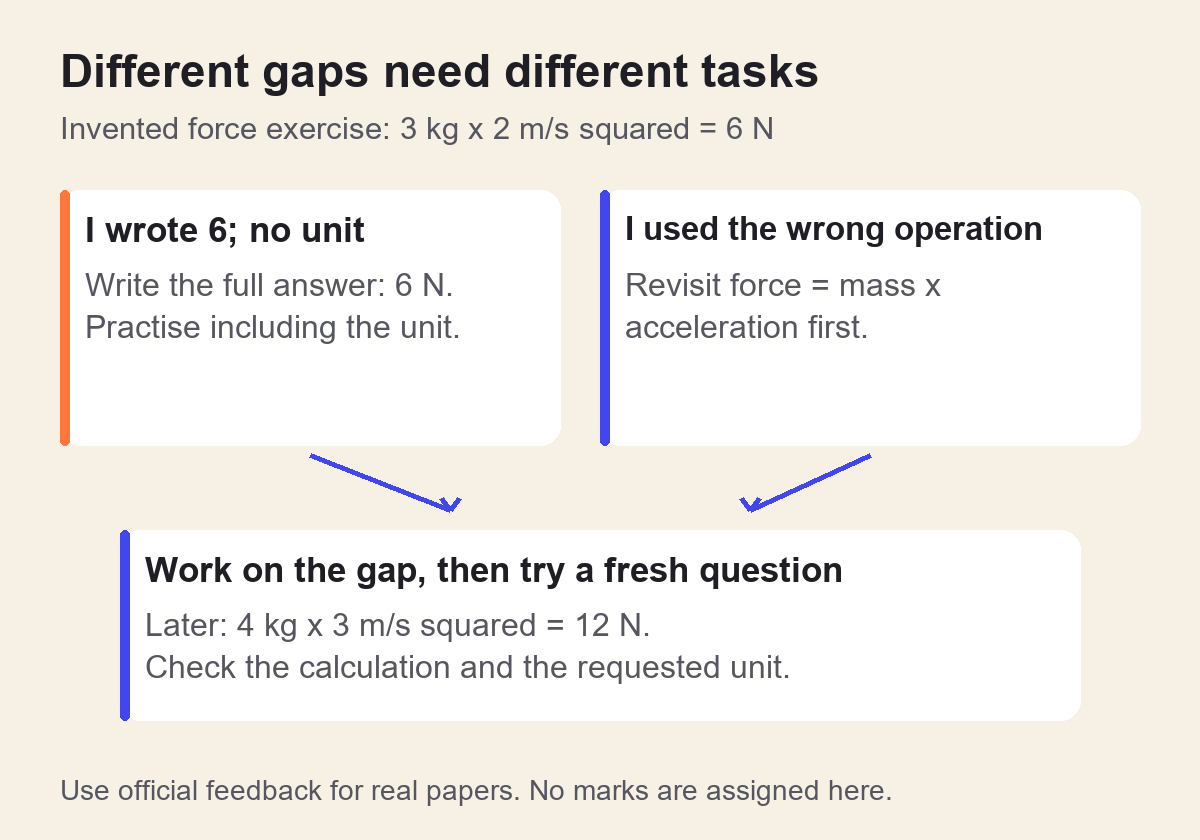
Here is an original teaching exercise, not a question or mark scheme from an exam board: "A mass of 3 kg accelerates at 2 metres per second squared. Using force = mass multiplied by acceleration, calculate the force and include the unit." The answer is 6 newtons, written 6 N.
Suppose your answer is "3 multiplied by 2 = 6". You have the calculation but omitted the requested unit. For this example, the next task is to check how force is written and practise including the unit, not to reread the entire chapter on motion. Official exams may award marks differently; use their scheme for real papers.
| What happened | Next practice task | Later check |
|---|---|---|
| The value was correct but the unit was absent. | Write the full answer as 6 N and explain what N stands for. | Try 4 kg at 3 metres per second squared: write 12 N. |
| You added mass and acceleration instead. | Revisit the given relationship and work one multiplication example. | Try another question without the worked example beside you. |
| You could not tell what the question asked. | Identify the instruction and the quantities provided. | Explain a new question in your own words before calculating. |
Keep the review small enough to use
A short log can contain the question reference, what went wrong and one follow-up task. "Question 4: forgot unit; practise three short calculations with units" is more usable than "bad at physics". The number of questions is an example to adjust.
Then try to bring the answer or method to mind on a later day. Reviews support practice testing and spreading practice across sessions, with later classroom research also finding benefits from quizzing. That evidence concerns learning; it does not mean this particular log will lower anxiety or guarantee a grade. [3] [4]
What if the marking feels confusing or discouraging?
If you cannot tell whether your reasoning meets the scheme, ask a teacher or tutor about one specific response. Extended answers can be difficult to judge yourself. Do not quietly turn an uncertain self-mark into a firm predicted grade.
If seeing the score makes you want to stop, cover the total for the moment and choose one answer to understand. You can take a break and return with help. Finishing many papers is not the goal if the same gap remains unaddressed.
For the next full timed attempt, use a pacing plan. For persistent distress or difficulty beginning, ask for support rather than making the practice schedule harsher.
Sources and further reading
These links open external research and health-information websites.
- Open University: reviewing what you know
Question practice, planning answers and checking gaps. Checked 18 October 2026. - Cambridge International: practice for exams
Official descriptions of syllabuses, past/specimen papers and mark schemes. Checked 18 October 2026. The force exercise on this page is our own illustrative material. - Dunlosky and colleagues (2013): effective learning techniques
Review of learning evidence, checked 18 October 2026. Does not test this workflow as an intervention for exam anxiety. - Yang and colleagues (2021): classroom quizzing review
Original full text checked 18 October 2026. Benefits varied with factors including feedback and tasks; the study does not validate this log as an anxiety treatment.
Educational guidance, not clinical advice. If you need a person, skip the rest of the steps and talk to one.