
Too Stressed to Study? How to Start Revising When You Feel Overwhelmed
If you are too stressed to study, choose one small task instead of solving the entire revision plan first. Open one resource, pick a question or paragraph, and try one part. Then decide whether to continue, pause or ask for help. NHS self-help guidance suggests trying a task for just five minutes to make starting more manageable; that is an option, not a required study interval. [1]
Try this for your next small start
You do not have to feel fully calm or motivated before attempting a small piece of work. Equally, being unable to work is not proof that you need to push harder. Start by making the task clear and checking what is in the way.
- Choose one subject and one resource. Put the rest out of view for now if you can.
- Name a visible task, such as opening the chapter and finding the example you do not understand.
- Try one part, with a short timer only if a timer helps. Five minutes is an option, and less can be a starting point.
- At the stopping point, note what happened. Continue a little, take a break, or identify the help you need.
What is making the start difficult?
A smaller task helps with some problems; others need a different response. You might not know what the assignment means, lack the right materials, feel unwell, or have nowhere usable to work. These are concrete barriers, not character flaws.
Use this table to choose a response to the situation you actually have. It is a planning aid, not a way to diagnose anxiety or explain every period of avoidance.
| The barrier | A possible first action |
|---|---|
| The task is too vague. | Replace revise chemistry with read one worked example and identify the first step. |
| You do not understand the material. | Write down the exact point of confusion and ask for an explanation. |
| Materials or instructions are missing. | Find the course page or ask the teacher which resource to use. |
| Your space or schedule is difficult. | Ask about a library, quiet room or a realistic change to commitments. |
| Distress or feeling unwell is stopping daily activities. | Tell someone and seek appropriate support; do not rely only on task tricks. |
Choose a task small enough to name
If "do a past paper" is too much, try "find one question on a topic I have studied". If that is still too much, try opening the paper and reading one instruction. You can enter at the size that is workable today.
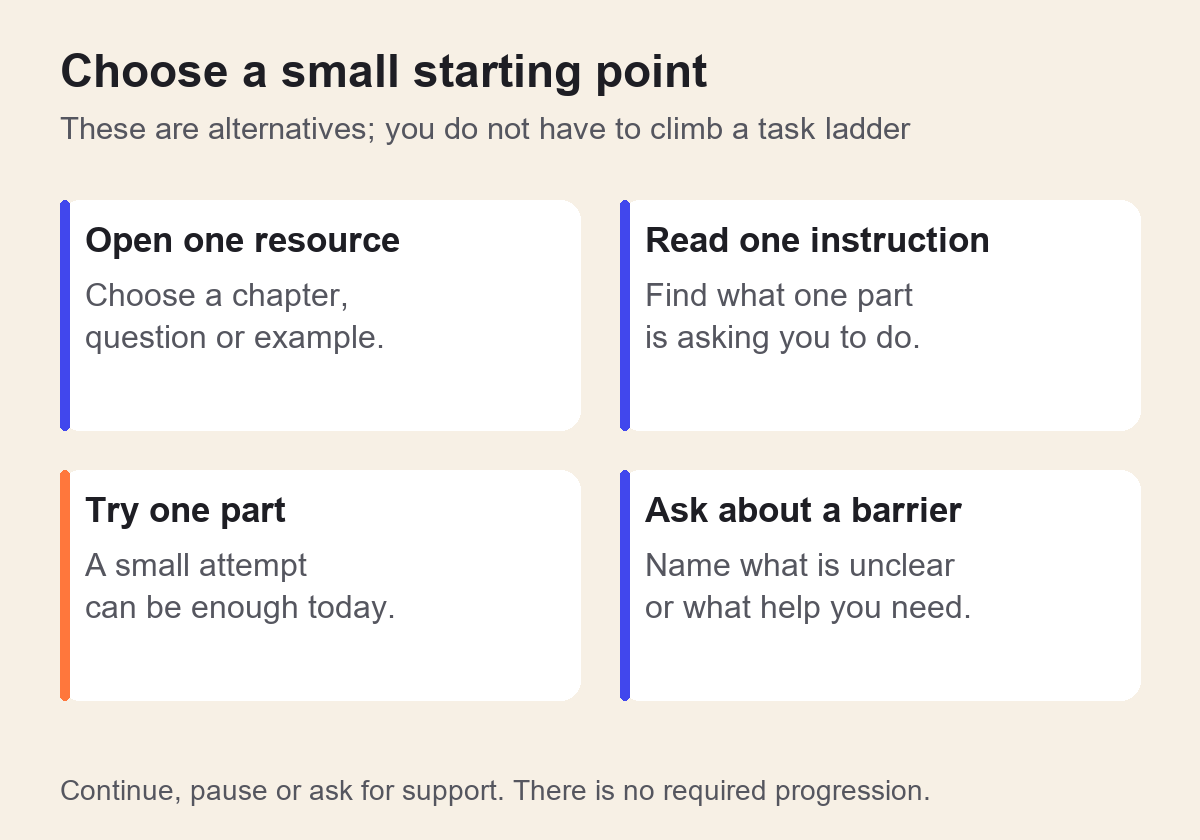
NHS guidance on tackling tasks suggests looking at when and where a task may be easiest to approach, alongside a balance of necessary and enjoyable activities. Adapt that to your circumstances; you may not control your space or have an uninterrupted afternoon. [1]
An example: from a closed folder to one attempt
Imagine you need to revise linear equations but have been avoiding the folder. Your first task is simply to find the worked example for solving 2x + 3 = 11. Read the example, then cover it and try the first step yourself.
Subtracting 3 from each side gives 2x = 8; dividing by 2 gives x = 4. If you get stuck at subtracting, the next task is to understand that step. If you can solve it, try a similar question. This is an original teaching example, not a record of a student we treated.
After a short attempt, write a starting cue for later: "Try 3x + 2 = 14, then check by substituting x = 4." That is enough to give the next session a beginning. It does not commit you to a long session now.
What if the deadline keeps taking over your thoughts?
You may need both an immediate task and a realistic conversation about priorities. Ask a teacher which topics or requirements deserve attention first. Avoid spending the entire available period designing a timetable you cannot carry out.
Once you have started, put a small number of named tasks into the time actually available, with breaks and a stopping point. A missed day does not need to become a punishment schedule. The timetable guide below gives a worked example you can adapt.
Protect sleep rather than using an all-night catch-up as the price of beginning. NHS exam-stress guidance advises against all-night cramming and encourages practical support with revision. [2]
If a small task still feels impossible
Try saying what the barrier looks like: "I open the notes and feel too overwhelmed to do anything. Can you help me choose the first task?" You can ask someone to sit with you, clarify instructions or help make contact with a tutor. They do not need to supervise every minute.
If this keeps happening, or distress is disrupting sleep, eating or everyday life, ask a counsellor or health professional for support. You do not have to complete this guide successfully before asking. A task can be made smaller; a need for support should not be dismissed as a motivation problem.
Sources and further reading
These links open external research and health-information websites.
- NHS Every Mind Matters: tackling your to-do list
General self-help suggestions including a five-minute start and balancing activities. Checked 18 October 2026. Our task sizes and maths example are editorial suggestions, not a validated treatment. - NHS: help your child beat exam stress
Guidance for families supporting young people, including revision support and avoiding all-night cramming. Checked 18 October 2026; no age-specific sleep prescription is given here.
Educational guidance, not clinical advice. If you need a person, skip the rest of the steps and talk to one.