When to get professional help for exam stress
Consider professional help if exam stress feels hard to manage, keeps going, makes you avoid things, or gets in the way of sleep, eating, or everyday life, especially if what you have tried is not helping. You do not need a diagnosis or a high questionnaire score first. A school or college counsellor, a doctor, or a talking therapy service are common places to start. If you might harm yourself, get urgent help now. [1] [2]
If you need help right now
If you might harm yourself, cannot keep yourself safe, or someone's life is at risk, contact emergency services now and tell someone near you what is happening. Do not wait for exams to finish.
In the UK, the NHS says to call 999 or go to A&E if a life is at risk, and to call NHS 111 for urgent mental health advice. Samaritans can be reached on 116 123, and Childline on 0800 1111 for under-19s. In the US, you can call or text 988, the Suicide & Crisis Lifeline. Elsewhere, use your local emergency number. [3] [2]
Signs it may be time to get help
There is no single cut-off. Health guidance points to a few things worth taking seriously: stress or anxiety that interferes with everyday life, makes you avoid things, or seems to be there all the time. For young people, NHS guidance suggests contacting a GP when anxiety or low mood is severe, persists, and interferes with everyday life. [2] [1]
It also counts if you have tried the usual things, such as a revision plan, breaks, sleep, or talking to someone at home, and they are not making enough difference.
Good grades do not rule it out. You can be keeping up with work and still be struggling badly, and that is a good enough reason to ask.
- The worry is hard to switch off, most days.
- You are avoiding revision, lessons, or exams themselves.
- Sleep, eating, or your mood have changed and are not recovering.
- It is still there after exams, or it has been building for weeks.
- You have thoughts of harming yourself. If so, get urgent help.
Who you can talk to
Where you study is often the quickest place to start. Schools, colleges, and universities may have a counsellor, wellbeing team, or student support service. In the US, NIMH notes that students may be able to get mental health support through their school's health center. [4]
A doctor is another starting point. In the US, a primary care provider can do an initial mental health check and refer you on. In the UK, a GP, teacher, or school nurse can put a young person in touch with children and young people's mental health services, and some areas let you refer yourself. [4] [5]
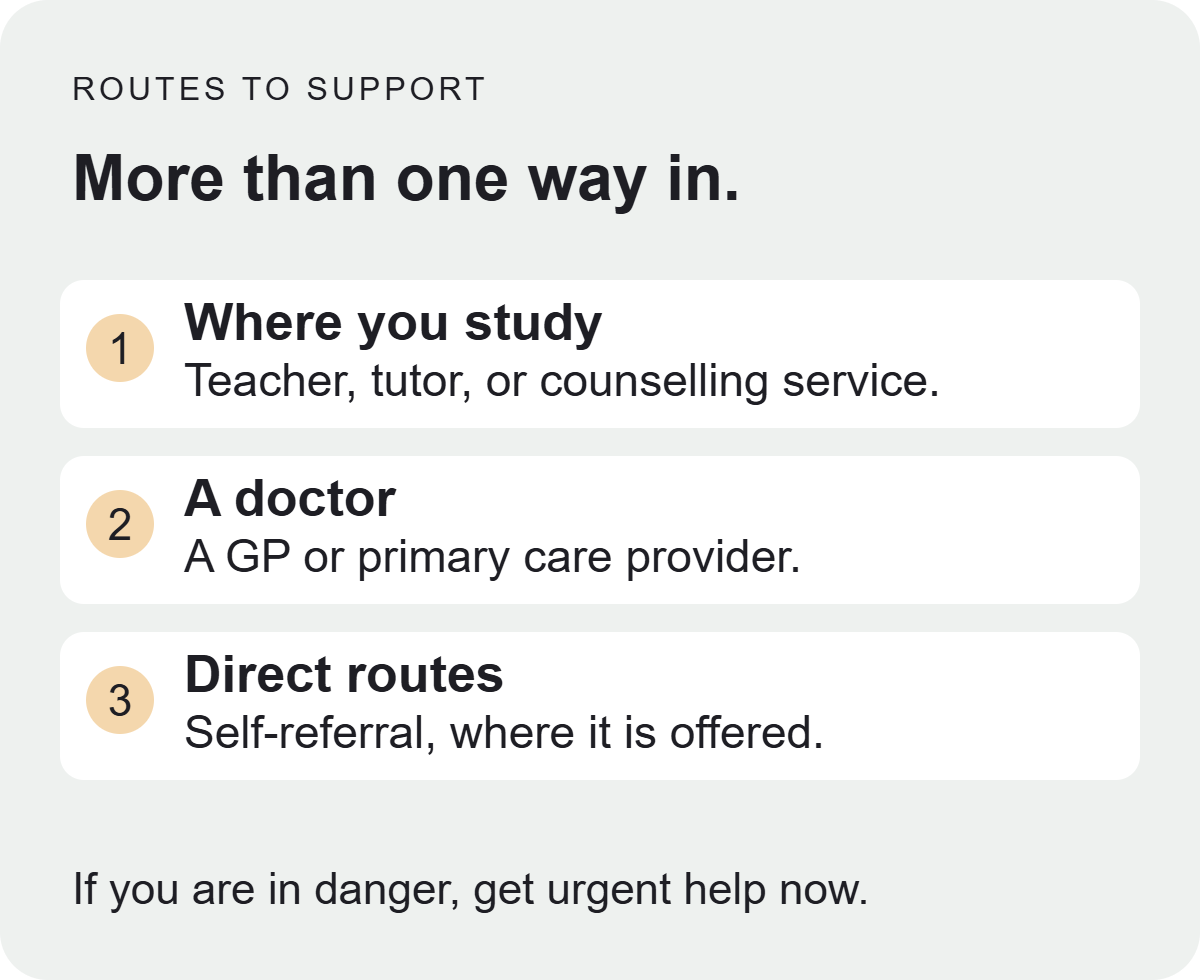
Adults in England who are registered with a GP can usually refer themselves to NHS Talking Therapies for anxiety without seeing a GP first. The NHS says this is for people aged 18 or over, or 16 or over in some areas. Services and rules differ between countries and regions, so check what is available where you live. [6]
What might happen when you ask
A first conversation usually means being asked what you have been feeling, how long it has been going on, and what it is affecting. You do not have to have the right words. Describing what is happening in everyday terms is enough.
What you are offered depends on the service and what you need. Options include self-help materials, guided self-help, talking therapies such as cognitive behavioural therapy (CBT) or counselling, and sometimes medication. NHS guidance for young people says some people find self-help or one or two sessions enough, while others need longer or more specialist support. [5] [6]
There may be a wait, especially during busy times of year. If exams are close, say so; it helps people understand the timing. Ask your school or exam centre separately whether any support with exam arrangements is possible, as the rules depend on the exam provider.
How to prepare for an appointment
A few notes can make a short appointment easier. NIMH suggests writing a list of what you want to discuss, being specific about when symptoms started, how severe they are, and how often they happen, and mentioning big stresses or changes in your life. [7]
You could bring a sentence like: "Since my mocks started, I have been sleeping badly and cannot stop worrying about exams. It is affecting my concentration and I have started missing lessons."
If you are unsure about a suggested option, you can ask what else is available. NIMH notes there is no one-size-fits-all treatment. [7]
- What you have been feeling, and since when.
- What it is affecting: sleep, eating, study, friends, or something else.
- What you have already tried, and whether it helped.
- When your exams are.
- Any questions, such as who will be told and what happens next.
Will anyone else be told?
This depends on your age, where you live, and the service. NHS guidance for young people says what you say will be kept confidential unless services are worried about your safety or someone else's. [5]
If you are worried about who will find out, it is fine to ask at the start: "What stays private, and when would you need to tell someone else?"
Does professional help work for exam stress?
There is reasonable evidence that it can. A review of 44 trials with test-anxious university students found that structured support reduced test anxiety compared with no support, and also improved academic performance. Behaviour therapy had the most support. The authors found signs of publication bias and poor reporting, so the size of the benefit is uncertain. [8]
Those studies were with university students, so they cannot promise what will happen for any one person, or for younger students. They do suggest that asking for help is a reasonable step, not a last resort.
Sources and further reading
These links open external research and health-information websites.
- NHS: help your child beat exam stress
Signs of exam stress and when to contact a GP, written for parents of young people. - NIMH: I'm so stressed out! fact sheet
When stress or anxiety calls for professional help, and the US 988 Suicide & Crisis Lifeline. - NHS: where to get urgent help for mental health
UK urgent routes: 999, A&E, NHS 111, Samaritans, and Childline for under-19s. - NIMH: help for mental illnesses
US routes to care, including primary care, FindTreatment.gov, and school health centers. - NHS: children and young people's mental health services
How young people in England reach services, confidentiality, and the kinds of support offered. - NHS: NHS Talking Therapies
Self-referral for adults in England registered with a GP; ages and therapy types. - NIMH: tips for talking with your health care provider
How to prepare for an appointment and questions to ask. - Huntley and colleagues (2019): interventions for test-anxious university students
Meta-analysis of 44 randomised trials. Evidence of publication bias and poor reporting; longer-term evidence is limited.
This article is educational. It is not a diagnosis or a treatment plan. If stress is affecting sleep, eating, or safety, talk to a GP, counselor, or local mental-health service.