Should you sleep or revise for one more hour?
Usually, sleep. Sleep helps your brain hold on to what you have learned and keeps your attention working the next day, and a short final review cannot make up for that. One more hour can make sense if it is a quick, focused recall task and you will still get a reasonable night. Staying up all night to learn new material is usually a bad trade. [1] [2] [3]
The short answer
If you are choosing between a few more hours of revision and a proper night's sleep, choose sleep. NHS guidance on exam stress says cramming all night is usually a bad idea, and that sleep will help more than a few hours of panicky last-minute study. [1]
An extra 30 to 60 minutes is a closer call. It depends on what you would do with it, how much sleep you can still get, and when you need to be up. The questions below can help you weigh it up. They are practical suggestions, not a formula tested in research.
Why sleep matters for an exam
Sleep after learning helps memories settle in. Researchers call this consolidation: while you sleep, the brain appears to strengthen and reorganise what you took in during the day. [2]
Sleep before a demanding day matters too. In one brain imaging study, people who had missed a night's sleep were worse at forming new memories the next day than people who had slept. [4]
Going without sleep also affects attention. A review of sleep deprivation studies found the largest effects on simple attention, with lapses where people briefly lose focus, and clear effects on working memory, the mental space you use to hold information while you work with it. Reasoning was less affected in those studies. [3]
Those studies mostly looked at a full night or more without sleep, not an hour less. They show why protecting sleep is sensible, not exactly what one hour costs.
How to decide tonight
Ask yourself three questions before you carry on.
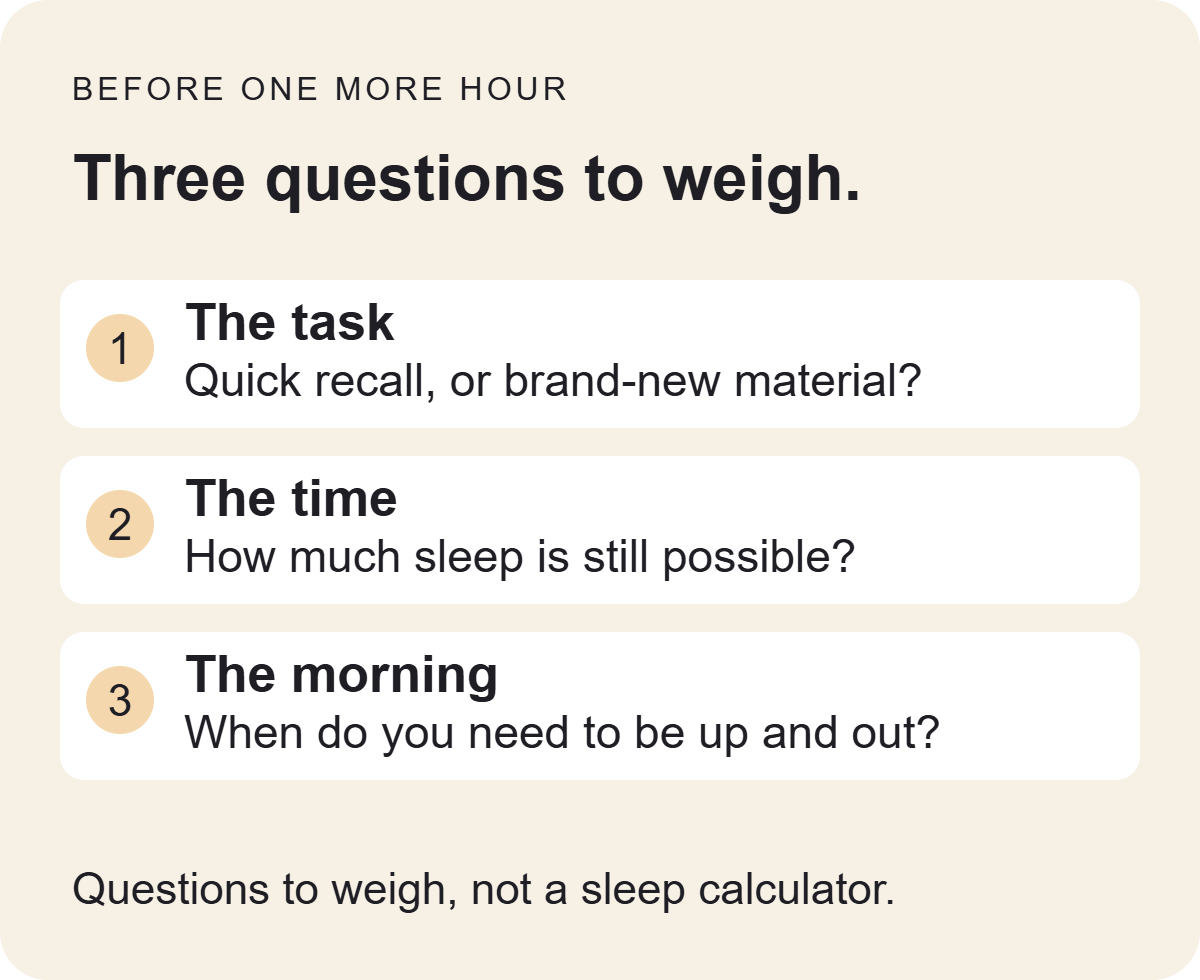
| Question | Leans to one more hour | Leans to sleep |
|---|---|---|
| The task | Quick recall on known material | New topic, or rereading |
| How you feel | Alert and focused | Rereading lines, more anxious |
| Night left | Still a reasonable sleep | Already a short night |
| Tomorrow | Later start | Early start or long journey |
If you do one more hour, make it count
Choose a task with an end point. Testing yourself, such as answering a few practice questions or writing down what you remember about a topic without notes, is a more useful kind of study than rereading or highlighting. [5]
Set an alarm for when you will stop, and stick to it. When it goes off, write down one thing to look at in the morning if there is time, then start winding down.
- Pick one topic you already know reasonably well.
- Test yourself on it for a fixed time, without notes.
- Check your answers and note one thing to glance at tomorrow.
- Stop at the alarm and start getting ready for bed.
What about an all-nighter?
Staying up all night is the option most likely to backfire. After a night without sleep, attention lapses become more common and forming new memories gets harder. [3] [4]
In one small study, college students who had been awake for 24 hours did worse on a critical thinking test than students who had slept, yet rated their own concentration, effort, and performance higher. A later, larger study found people could still roughly judge their performance after sleep loss, so the evidence here is mixed. Either way, feeling fine is not a reliable sign that you are. [6] [7]
If you are so far behind that an all-nighter feels like the only option, it may be worth telling a teacher, tutor, or someone at home. That is a sign the workload needs looking at, not a failure on your part.
If you are already short of sleep
Try not to panic about one bad night. In a study of college chemistry students, sleep over the week and month before a test was linked to their marks, but sleep on the single night before was not. That was a correlation in one class, so it does not prove one night never matters, but it does suggest the pattern over time counts for more. [8]
If you cannot sleep, you do not have to force it. Our night-before guide has ideas for winding down and what to do if you are lying awake.
In the morning, eat something if you can, give yourself extra time to get there, and read each question carefully. If you feel unwell during the exam, tell the person supervising.
Sources and further reading
These links open external research and health-information websites.
- NHS: help your child beat exam stress
Advice on sleep and avoiding all-night cramming before exams, written for parents of young people. - Rasch and Born (2013): about sleep's role in memory
Review of research on how sleep supports memory consolidation. - Lim and Dinges (2010): short-term sleep deprivation and cognition
Meta-analysis of 70 studies of up to 48 hours without sleep. Largest effects on simple attention; smallest on reasoning accuracy. - Yoo and colleagues (2007): forming new memories without sleep
Laboratory brain imaging study of one night of sleep deprivation before learning. Not an exam study. - Dunlosky and colleagues (2013): effective learning techniques
Rated practice testing as high utility and rereading and highlighting as low utility. - Pilcher and Walters (1997): sleep deprivation and college students' cognitive performance
Small study of 44 college students after 24 hours awake. Performance fell while self-ratings rose. - Sundelin and colleagues (2026): sleep loss and judging your own performance
Randomised study of 182 adults. Found only a small drop in awareness of performance after a night without sleep. - Okano and colleagues (2019): sleep and academic performance in college students
88 students in one chemistry class wore sleep trackers. Correlational; sleep on the single night before a test was not linked to its score.
This article is educational. It is not a diagnosis or a treatment plan. If stress is affecting sleep, eating, or safety, talk to a GP, counselor, or local mental-health service.