
How to Finish an Exam Paper on Time
To give yourself a better chance of finishing, divide the available time between the required questions, allow for reading and checking, and choose points to check your progress. Practise moving on when a question uses its allowance, where the exam permits returning. A plan helps you make decisions; it cannot guarantee you will complete every paper. Newcastle University recommends budgeting with time, question requirements and marks in mind. [1]
Make a plan before the first long answer
Use the actual instructions for your exam. Some papers let you choose questions or return to earlier answers; others do not. Do not use a skipping strategy in a test that locks completed sections.
Try these steps in a practice paper first. You are aiming for a small number of useful decisions, not another complicated thing to remember.
- Check the total answering time and exactly which questions you must attempt.
- Allow some of that time for reading, planning and checking, unless separate reading time is explicitly provided.
- Divide the remaining time between questions or sections, taking their marks and format into account.
- Write a few elapsed-time checkpoints in a permitted place, or remember the clock times they correspond to.
- At each checkpoint, decide whether to continue briefly or move on. Keep track of unanswered parts if you can return to them.
A worked example: 90 minutes and 60 marks
This invented paper has three required sections worth 20 marks each. All 90 minutes include reading and checking; there is no separate reading period. For this example, reserve 5 minutes at the start and 10 at the end. That leaves 75 minutes for answers: 25 per section.
The calculation is 90 minus 5 minus 10 = 75; then 75 divided by 60 = 1.25 minutes per mark. This is a rough budgeting tool. A one-mark item and an extended answer do not necessarily take time in exact proportion, so adjust after practising the actual format.
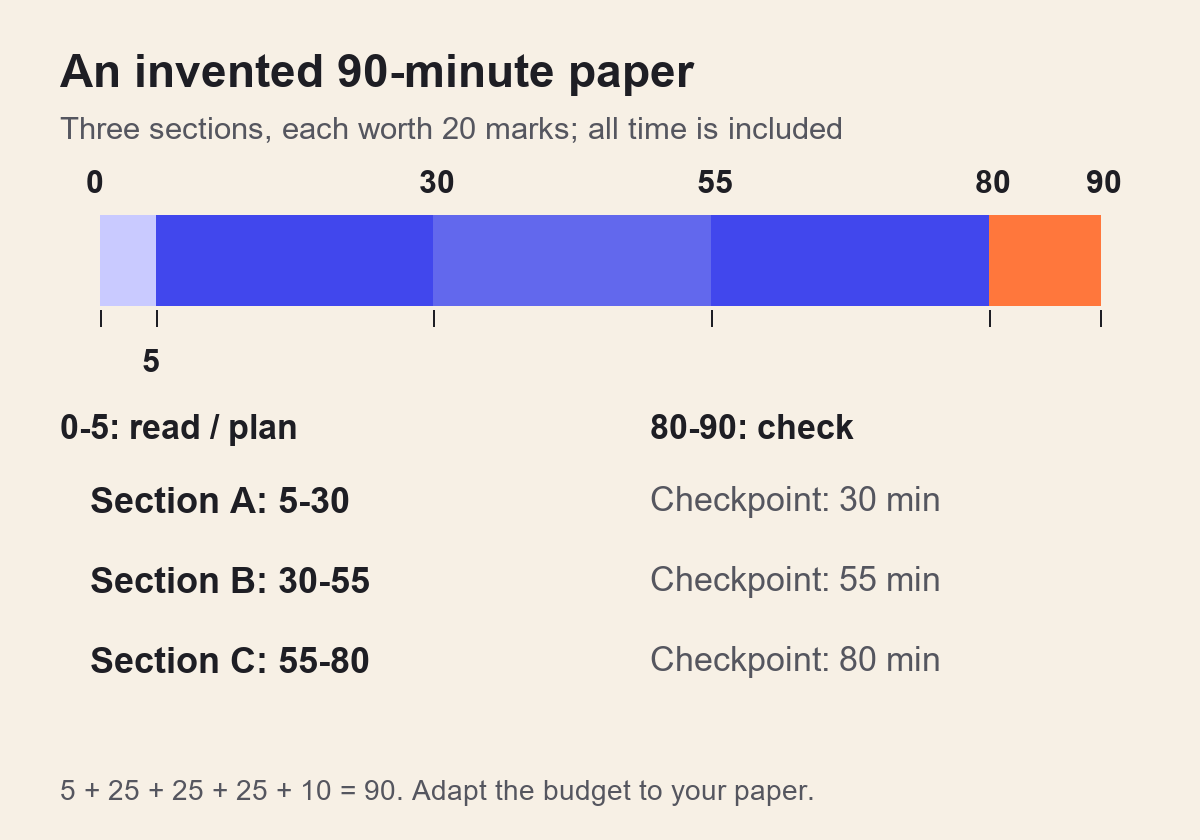
| Elapsed minutes | Example task | Checkpoint |
|---|---|---|
| 0 to 5 | Read instructions and plan the order. | Know which questions are required. |
| 5 to 30 | Section A: 20 marks. | At 30 minutes, move towards section B. |
| 30 to 55 | Section B: 20 marks. | At 55 minutes, move towards section C. |
| 55 to 80 | Section C: 20 marks. | At 80 minutes, begin the final review. |
| 80 to 90 | Return to gaps and check answers. | Stop when instructed. |
Which question should you start with?
First check whether you have a choice. If you do, a question with a clear starting point may be easier to begin than the one that looks hardest. Still give the required sections their share of time; an attractive first answer can absorb the whole paper.
Read the whole instruction before committing. A familiar topic may come with an unfamiliar task, such as evaluating an argument rather than describing it. Newcastle highlights question selection and close reading as parts of exam technique. [1]
For an essay, leave room inside the allowance to plan its direction. For a calculation, show required working as you go. A time budget should include what earns credit, rather than assume you can omit it to write faster.
What if you are already behind?
Suppose the example clock reaches 35 minutes and you are still in section A. You have used five minutes more than planned. Notice it now, rather than discovering at the end that section C has no time left.
If returning is allowed, mark the unfinished part clearly, move to a question you can attempt and revisit the gap in the review period. If the remaining work is substantial, re-budget the time left across the remaining required sections. Do not assume you can recover everything by writing faster.
The choice depends on the paper and what you can answer. There is no universal rule to abandon a question after a fixed number of seconds. Your practice attempts can help you recognise when you are making progress and when you are repeating the same unsuccessful step.
Use the review time for identifiable gaps
Start with required questions or parts you accidentally left empty, if the format permits returning. Then check the points most likely to change an answer: instructions, copied values, units, question numbers and whether you included the requested reasoning.
Do not continue writing after the supervisor tells you to stop. The example review allowance is simply a way to plan within your permitted time.
Practise the decisions, not just the speed
Use an official past or specimen paper that matches your syllabus. Cambridge recommends simulating exam conditions and using the mark scheme to assess performance. [2]
Afterwards, record where time went: choosing, understanding the question, recalling material, planning or writing. If one kind of question always takes longer, ask a teacher to look at an example answer with you. You may need technique or subject help rather than another timer.
If reading, writing or another difficulty consistently prevents access to the paper, raise it with your institution before the exam. Available support and any arrangements depend on its rules; this guide cannot establish eligibility.
Sources and further reading
These links open external research and health-information websites.
- Newcastle University: exam technique for in-person exams
Practical time budgeting, question selection and reading guidance, checked 18 October 2026. Our 90-minute example uses its own illustrative numbers. - Cambridge International: practice for exams
Official guidance on practice conditions and mark schemes, checked 18 October 2026.
Educational guidance, not clinical advice. If you need a person, skip the rest of the steps and talk to one.