
Why You Make Silly Mistakes in Exams and How to Catch Them
What you call a silly mistake might be a misread instruction, a copied number, a calculation slip, or a gap in understanding. These need different responses. Look at an actual example before blaming yourself, then choose one specific check to practise. Reading the question carefully and allowing time to check are established pieces of exam-technique advice. [1]
First, find out what went wrong
You knew what to do, but your answer says something else. Calling that careless tells you little about where to intervene. Keep the question, your working and the correction together so you can compare them.
Try the categories below on one marked answer. They are a practical way to investigate an error, not a psychological test. More than one can apply.
| What happened? | What to try next |
|---|---|
| You answered a different question. | Identify the instruction and the exact thing the answer must include. |
| A number, sign or word changed while copying. | Compare that line directly with the original before checking later working. |
| The method was right but one calculation was wrong. | Rework that step separately; estimate whether the result is plausible. |
| You cannot explain why the method works. | Review the concept or ask for an explanation before doing more timed questions. |
Why can the mistakes show up more in exams?
A paper asks you to understand instructions, decide what is relevant, work out answers and watch the time. Knowing a topic is only part of that task. Newcastle University treats reading, planning and time management as separate exam skills. [1]
Look for the point where your process changed. Did you rush the instruction because the clock worried you? Did you leave all checking until the end and never reach it? Or does the same error happen during untimed practice?
Those observations help you choose what to practise. They do not prove that anxiety caused the mistake, or that knowing the material at home guarantees the same result in the exam.
Give your checking a specific job
Instead of looking over an answer and asking whether it seems right, ask a question you can answer: did I use the number in the question, keep the minus sign, and include the requested unit?
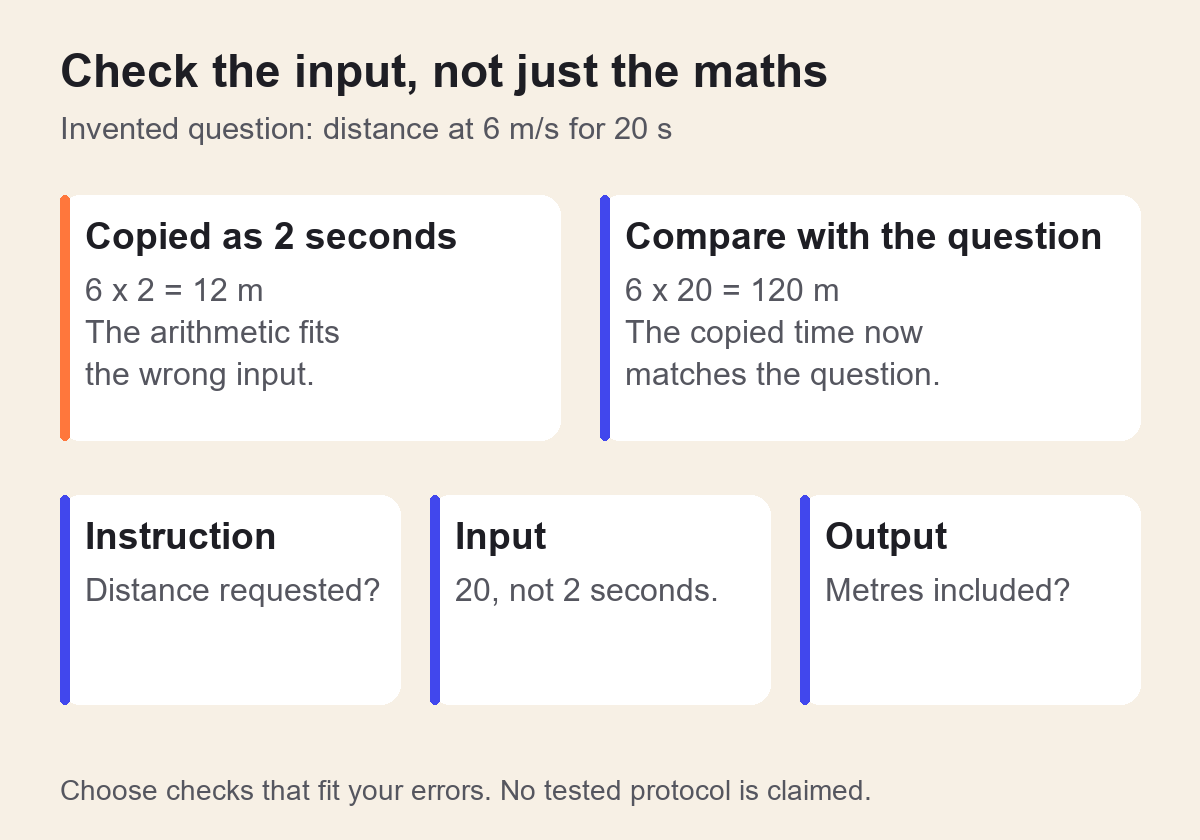
For a written answer, compare the instruction with what you actually wrote. If it asks you to compare two explanations, describing only one may leave the task unfinished. Reading the rubric and question closely matters as much as writing relevant facts. [1]
- Instruction: have I done what the question asks, including any second part?
- Input: do the values, signs, names and dates match the question?
- Output: is the final answer in the requested form, with units or supporting reasoning where needed?
An example: the answer is right for the wrong number
Imagine a practice question asks for the distance travelled at 6 metres per second for 20 seconds. You copy 20 as 2, multiply correctly and write 12 metres. Repeating the multiplication will not find the copying error.
Compare the input with the question first: 6 multiplied by 20 gives 120 metres. An estimate is another useful question here: travelling for 20 seconds should cover more ground than travelling for 2 seconds. This is an invented teaching example, not an actual exam question.
In an essay, the equivalent might be a question asking for two reasons while your answer develops only one. A check against the task catches something that proofreading spelling would miss.
Practise one change before the next paper
Use an official practice question and its mark scheme to see where your answer missed the task. Cambridge recommends using mark schemes to assess practice answers and focus on weaknesses. [2]
Keep a small note with three columns: what happened, what I will check, and what happened on the next attempt. For example: copied a minus sign incorrectly; compare signs before the next line; try a different question later. This is a suggested record, not a requirement to catalogue every mistake.
Rehearse the check within the time available. You may need brief checks as you go and a final review; there is no universal checking allowance that fits every paper. If you regularly cannot finish, work on pacing rather than simply adding more checks.
When to ask someone to look with you
If the same thing keeps happening, take a few examples to a teacher or tutor. Ask: "Is this a misunderstanding, an issue with how I write the answer, or something I could catch with a check?" Specific work gives them more to respond to than a general complaint about carelessness.
If worries about mistakes are making revision hard to begin, you can ask for help with that too. You do not need to wait until your marks fall.
Sources and further reading
These links open external research and health-information websites.
- Newcastle University: exam technique for in-person exams
Practical guidance on instructions, time management and checking. Checked 18 October 2026; it does not validate the examples or checklist on this page. - Cambridge International: practice for exams
Explains syllabuses, practice papers and using mark schemes to identify weaknesses. Checked 18 October 2026.
This article is educational. It is not a diagnosis or a treatment plan. If stress is affecting sleep, eating, or safety, talk to a GP, counselor, or local mental-health service.