
Why You Forget What You Studied Before an Exam
If you forget what you study, look at how you check your learning as well as how long you spend on it. Recognising a familiar page is different from explaining it with the notes closed. Practice retrieving an answer, check the gaps and return later. Research supports recall practice and spreading learning across sessions, but neither guarantees a mark or explains every memory difficulty. [1] [2]
A familiar page can hide an unfinished answer
With the notes open, the headings and examples are already there. In an exam, you have to work out what matters and bring the information to mind yourself. A useful preparation question is: "Could I explain this without the page?"
In experiments with students learning prose, Roediger and Karpicke found that practising recall helped later retention compared with repeated study, even though repeated study increased confidence. These were controlled memory tasks, not a demonstration that one method prevents exam anxiety. [2]
Rereading is still useful when you need to understand an explanation or correct a gap. The change is to include a chance to produce an answer, rather than use familiarity as your only check.
Find the gap before choosing a technique
Try one short question without notes, then compare your answer with a reliable explanation. Notice what kind of help you need. This table is a practical starting point, not a diagnosis of your memory.
| What you notice | A possible next task |
|---|---|
| The explanation itself does not make sense. | Work through an example or ask someone to explain the missing step. |
| You understand it but cannot name the key points. | Try a small question, check what is missing, then try again later. |
| You remember a definition but cannot apply it. | Use a new example or an exam-style problem rather than another definition card. |
| It comes back with a hint. | Practise answering with fewer prompts, without treating one hinted answer as mastery. |
A worked example: turn one paragraph into practice
Suppose you are revising evaporation. Read a short explanation, then close it and answer: "What is evaporation, and how would I recognise an example?" Write or say your answer before reopening the explanation.
If you confuse evaporation with boiling, use the source to correct that difference. Then try explaining it with a different everyday example. You are looking for a specific gap to work on, not a verdict on whether you are good at science.
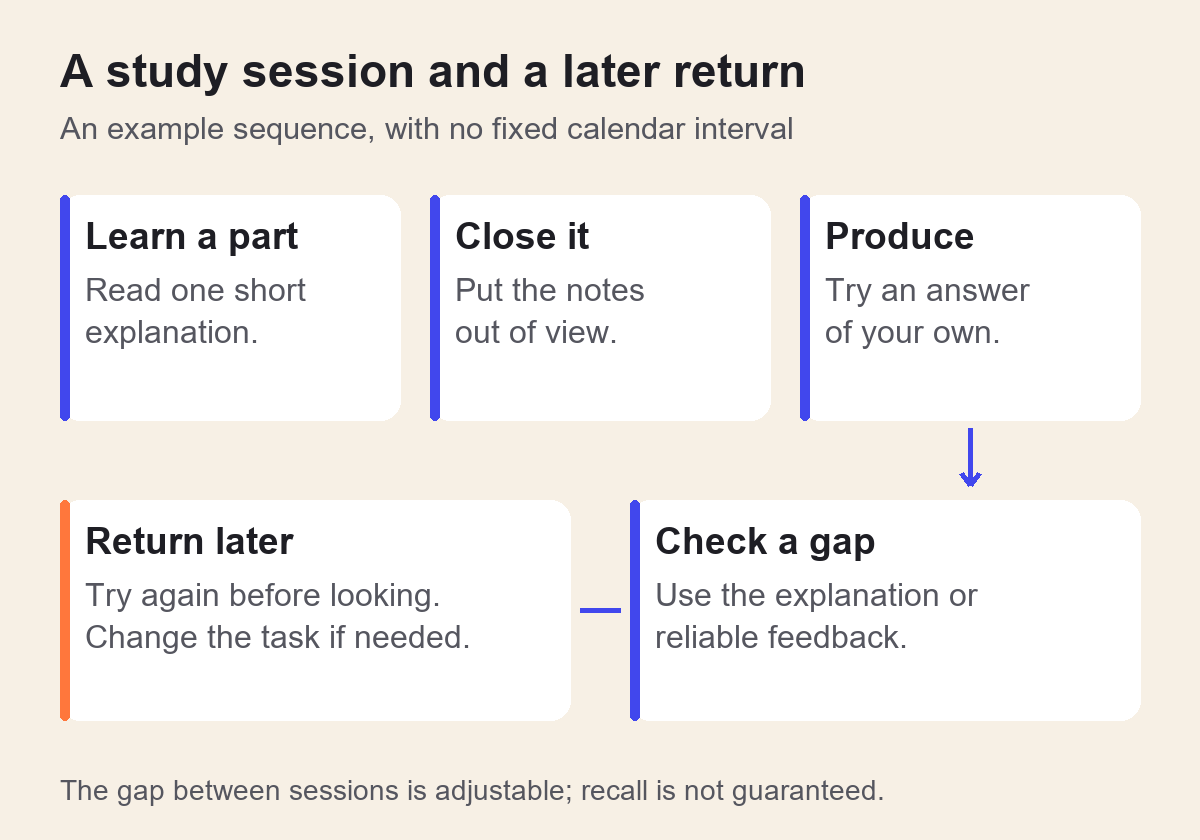
On a later study day, try the question again before rereading. The Open University recommends recalling first, reviewing missing material and trying another question. This example adapts that idea; its subject and timing are suggestions. [3]
Why come back on another day?
A major review of learning techniques rated practice testing and distributed practice, meaning study spread across sessions, as broadly useful. Benefits vary with the learner, material and task. That supports revisiting important topics; it does not establish a perfect timetable for your course. [1]
Later classroom reviews also found learning benefits from quizzing and from spreading practice out. Their findings depend on the tasks and study conditions, and they do not tell us that a particular revision routine will remove exam anxiety. [5] [6]
Write down a manageable return task, such as "answer two questions on evaporation before looking at notes". Put it into time you actually have. If you miss that session, resume at the next available one rather than trying to repay every missed minute.
If you have been studying only one question format, add the kind your exam uses. Flashcards can ask for facts; an explanation, calculation or essay also needs practice producing that sort of answer.
What if yesterday now feels unfamiliar?
Start with a small sample rather than retesting the entire chapter. Use the heading to try an outline, then check it. If nothing comes, read a short explanation and work through an example. A blank answer is information about where to restart, not a reason to keep staring at the whole syllabus.
Forgetting over study days and suddenly going blank under exam conditions are different situations. If you can answer in practice but cannot get started in the room, use the separate blanking guide alongside checking your preparation.
When this needs more than a study change
Do not assume every memory problem is a revision problem. If memory difficulties keep happening and affect everyday life, speak to a doctor or another appropriate health professional. NHS guidance advises getting persistent day-to-day memory problems checked rather than self-diagnosing their cause. [4]
If the immediate barrier is feeling too overwhelmed to open the material, begin with support and one manageable task. You do not need an elaborate memory system before you can start.
Sources and further reading
These links open external research and health-information websites.
- Dunlosky and colleagues (2013): effective learning techniques
Full review checked 18 October 2026. Supports learning techniques across varied settings; it is not evidence that this example treats anxiety. - Roediger and Karpicke (2006): test-enhanced learning
Published abstract checked 18 October 2026. Controlled prose-learning experiments; no numerical effect sizes or real-exam guarantees are drawn from it. - Open University: reviewing what you know
Practical guidance on trying recall, checking gaps and question practice. Checked 18 October 2026. - NHS: memory loss
Guidance to seek medical advice for memory problems affecting daily life. Checked 18 October 2026; no diagnosis is inferred here. - Yang and colleagues (2021): classroom quizzing review
Original full text and study moderators checked 18 October 2026. Classroom learning outcomes, not an anxiety-treatment comparison. - Mawson and Kang (2025): distributed classroom practice review
Original full text checked 18 October 2026. Applied classroom evidence with varied tasks and limited moderator analysis; no universal interval is established.
This article is educational. It is not a diagnosis or a treatment plan. If stress is affecting sleep, eating, or safety, talk to a GP, counselor, or local mental-health service.