
How to Stop Overthinking After an Exam
After an exam, try separating a useful next action from a question you cannot settle yet. Give answer checking a boundary, take a break and choose one thing to do next. You do not have to prove the paper went well before moving on. OCR advises against dwelling on a paper that felt bad; NHS worry guidance suggests making a plan for what you can act on and shifting attention when you cannot. [1] [2]
Start by stepping out of the answer discussion
If comparing answers is making you feel worse, you can leave the conversation without deciding who was right. Try: "I am taking a break from going through the paper. Can we talk about something else?"
Mute a chat for a while, put the notes away and move to the next ordinary part of your day: food, a journey home, a shower, or time with someone. These are possible boundaries, not rules that everyone must follow.
Talking about an exam is not automatically harmful. A brief discussion may clarify something useful. Notice whether you are learning one thing you can use or asking the same question again without feeling any more settled.
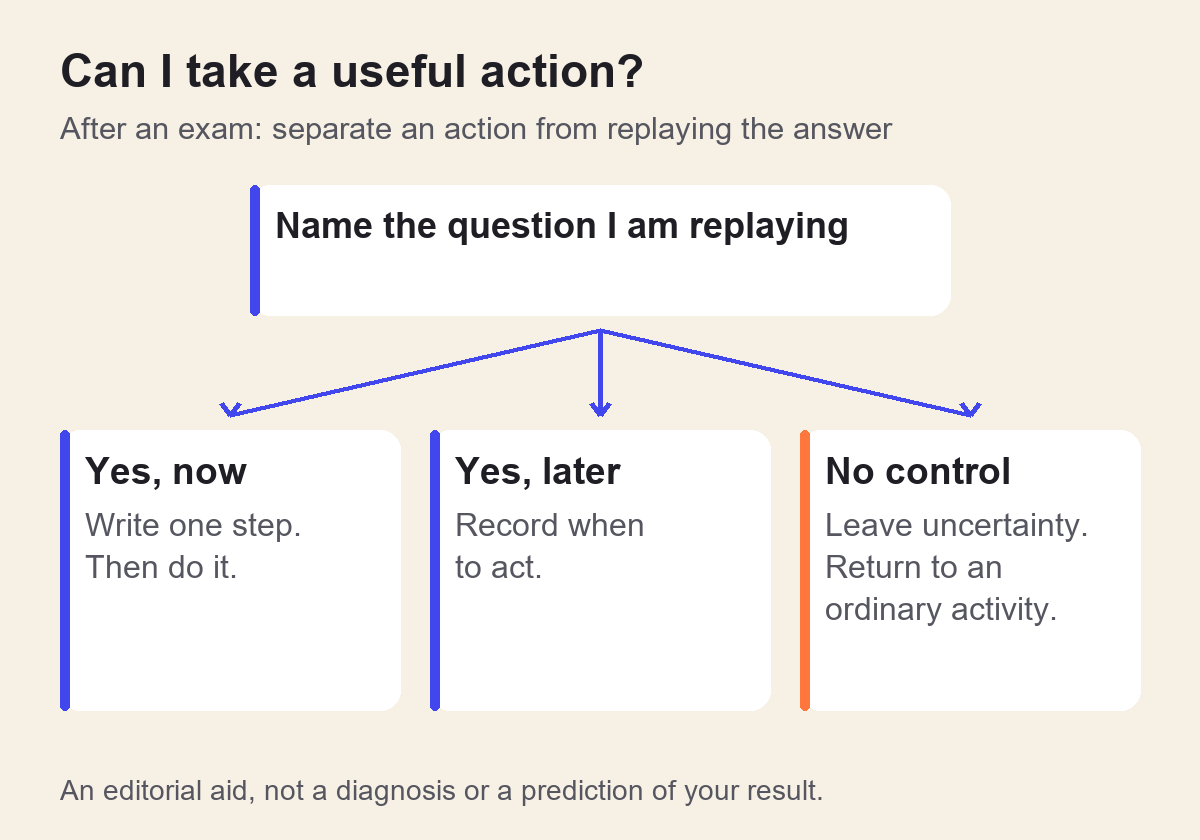
Ask: is there an action here?
NHS guidance distinguishes a problem you can act on from a worry outside your control. Try that distinction with the thought in front of you, rather than arguing with every possible outcome. [2]
For example, "I did not understand that topic" can lead to asking for an explanation before another paper. "What if the examiner dislikes every answer?" cannot be resolved by reconstructing the exam from memory.
| The thought | A possible response |
|---|---|
| I used the wrong method on that topic. | Record the topic once and plan a practice question if it matters for a future paper. |
| Something happened that the exam office needs to know. | Check the official reporting route promptly; do not rely on chat-room guesses about the rules. |
| I need to know my exact mark now. | An unofficial reconstruction cannot establish the official result. Put the calculation aside for now. |
| I should ask one more person whether my answer was acceptable. | Notice whether this repeats a question already discussed. Try leaving it unanswered for the moment. |
Keep a useful review small
When you are ready, you could write three short lines: what was difficult, what you would change for another paper, and the next action. Stop when you have an action, rather than when you feel certain about the result.
For instance: "Spent too long on question two. Practise moving on at a checkpoint. Use a time budget in tomorrow's paper." This is an invented example of planning, not a proven recovery exercise.
If reviewing is pulling you into more distressing replay, leave it for now and ask someone to help you decide what actually needs attention. There is no obligation to reconstruct the paper today.
What to do when the thought comes back
You may notice the same answer again while eating or trying to relax. You can acknowledge it without restarting the entire investigation: "I am worried about that answer. I have already written down the useful part." Then turn to the activity you chose.
If worries take over much of the day, NHS guidance offers the option of a short scheduled worry period. You could note a thought to revisit then, rather than follow it immediately. It is optional; if writing or reviewing keeps intensifying the loop, discuss that with a support professional. [2]
The aim is to make room for the rest of your day. It is not a demand to suppress thoughts or feel calm on command.
An example: there is another exam tomorrow
Imagine finishing a difficult morning paper and finding a chat full of competing answers. You mute it until tomorrow, have lunch and choose one afternoon task for the next subject. That task might be practising one essay plan, not revisiting every topic.
If a thought about this morning returns, write down any genuinely new action once. If there is none, return to the small task or break in front of you. Your next paper does not require a verdict on the previous one.
Keep an evening stopping point. Feeling uncertain about one paper is not a reason to turn the next night into an all-night review.
When to ask for support
If replaying answers or checking is repeatedly disrupting sleep, study or daily life, tell a teacher, counsellor or health professional what is happening. You can describe the time it takes and what it prevents you from doing without choosing a diagnostic label.
You can say: "After exams I keep checking answers and cannot move on to other things. Can we talk about some support?" This article offers practical starting points, not treatment for persistent checking or a mental-health condition.
Sources and further reading
These links open external research and health-information websites.
- OCR: managing stress
Official exam-board advice includes moving on from a paper that felt bad. Checked 18 October 2026. - NHS Every Mind Matters: tackling your worries
General self-help guidance on actionable worries, planning and optional worry time. Checked 18 October 2026; not an exam-specific trial or treatment for compulsive checking.
This article is educational. It is not a diagnosis or a treatment plan. If stress is affecting sleep, eating, or safety, talk to a GP, counselor, or local mental-health service.