Calm app review for students: sleep, stress, and cost
Calm is an app for meditation, sleep stories, music, and breathing exercises. Unlike Headspace, it has a real free version: Calm lists more than 230 free meditations, a few free sleep stories, and a breathing tool. Premium unlocks the full library, including over 300 sleep stories. One trial with stressed college students found lower stress after eight weeks, but there is little other trial evidence. It suits students who want something to listen to when they stop revising at night. Start with the free version. [1] [2]
Calm at a glance
Details checked on 21 September 2026 from Calm's help centre, its privacy policy, and its US App Store listing. Calm's main website blocked our automated check, so we did not see its current web prices.
| Question | What we found |
|---|---|
| Who is it for? | The App Store rates Calm 9+. We could not load Calm's terms to check a minimum age for an account. [3] |
| Which devices? | iPhone and iPad (iOS 18 or later), Android, and the web. [2] [3] |
| Is it free? | Yes. The free version includes more than 230 meditations, a few sleep stories, and a breathing tool. [1] |
| What does Premium cost? | Calm Premium was listed on the US App Store at prices from $14.99 to $79.99. Check the price in your own store before subscribing. [3] |
| How long does setup take? | Download the app and choose a session. Setup time was not measured here. |
| Main limitation | It offers audio to relax to. It will not fix a revision plan or treat a sleep problem. |
How we put this review together
On 21 September 2026 we read Calm's help centre articles on free content, Premium, and cancelling, its privacy policy, and its US App Store listing. We also read published research on Calm.
This is a review of published information, not a hands-on test. We did not install the app, start a trial, or listen to sessions. Calm's student plan page in its help centre asked us to sign in, so we could not confirm a current student discount.
What is free, and what does Premium add?
Calm says you do not need Premium to use the app. The free version includes more than 230 guided and timed meditations, 8 free sleep sessions including the sleep story Blue Gold, the first day of every multi-day program, a preview of the Daily Calm meditation, the Breathe Bubble breathing tool, and background nature sounds. [1]
A padlock icon marks Premium content. If there is no padlock, the session is free. [1]
Premium unlocks the full library: over 300 sleep stories, a new Daily Calm meditation every day, the full music catalogue, masterclasses, and movement sessions. Every route to Premium, whether a trial, a work benefit, or a paid plan, unlocks the same content. [2]
| Feature | Free | Premium |
|---|---|---|
| Meditations | More than 230 | Hundreds more |
| Sleep stories | 8 free sleep sessions | Over 300 |
| Daily Calm | A preview | A new session every day |
| Music | Background sounds | Full catalogue |
| Breathing | Breathe Bubble | All exercises |
How could Calm fit into exam season?
The most practical use is at the end of the day. Stopping revision can be hard when your mind is still going over topics, and having one audio session ready gives you a clear point to stop.
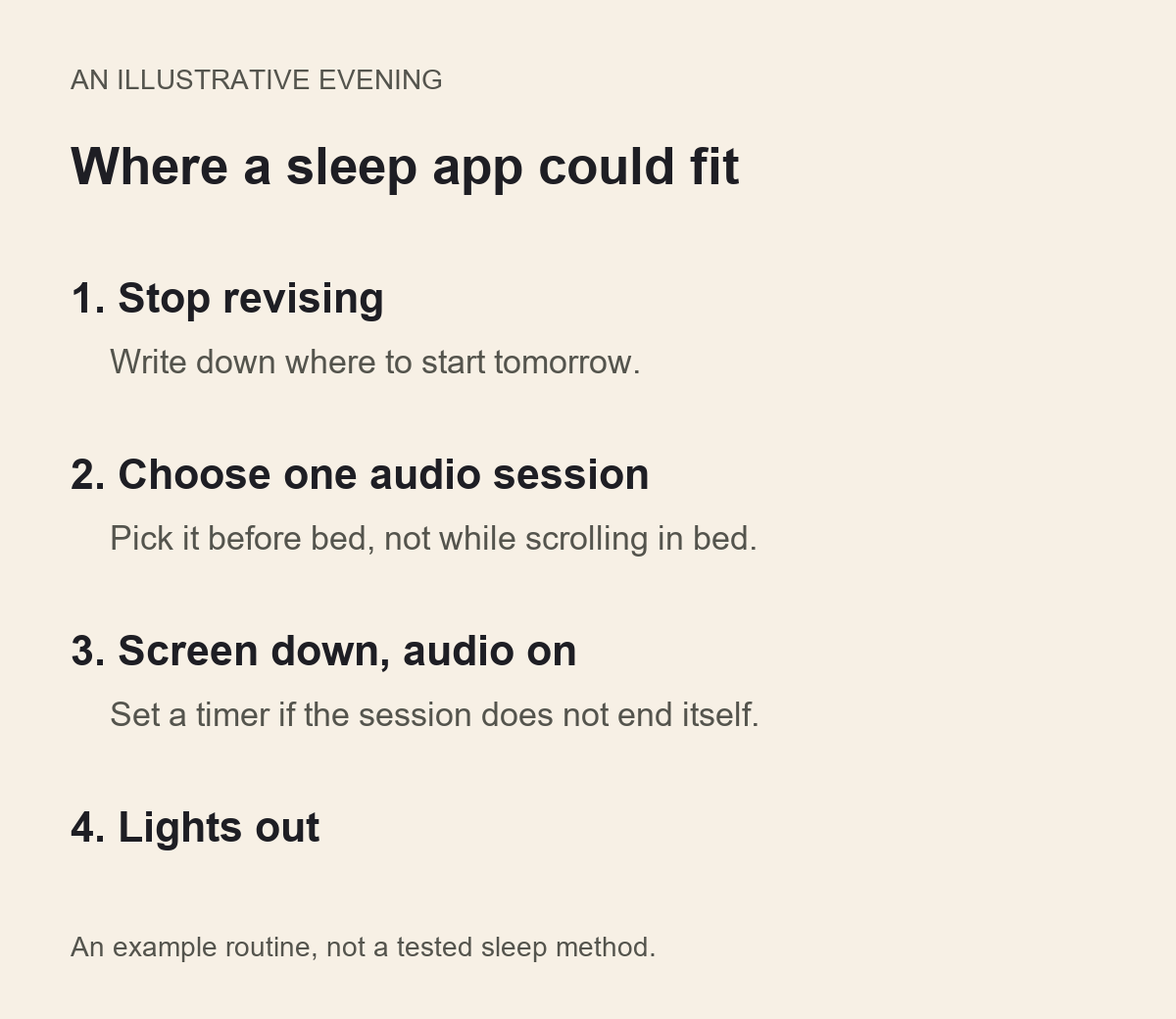
Choose the session before you get into bed, so you are not scrolling through the library with the screen on. If a session does not end on its own, set a sleep timer.
A short free meditation between revision blocks is another option. Our guide to calming down before an exam has techniques that need no app at all.
Does Calm help with stress and sleep?
There is one clear trial with students. Eighty-eight full-time undergraduates with high stress were asked to meditate with Calm for at least 10 minutes a day for eight weeks. Compared with students waiting to use it, they reported lower stress and more mindfulness and self-compassion, and the differences lasted to a follow-up four weeks later. On average they used it for about 38 minutes a week. [4]
That study compared Calm with a waiting list rather than another activity, relied on self-reports, and did not measure exam stress or results. A 2022 review of Headspace and Calm trials found only one randomised trial of Calm at the time, so the evidence for this app is thin. [5]
Calm's app listing describes breathing exercises to ease anxiety, stress, and insomnia. Treat that as the company's description. If you often cannot sleep, or stress feels unmanageable, talk to a doctor or someone you trust rather than relying on an app. [3]
Is Calm Premium worth paying for?
Calm offers a 7-day free trial of Premium. If you cancel before the trial ends, you are not charged and you keep the free content. [1]
On the US App Store, Calm Premium was listed at several prices between $14.99 and $79.99; the listing does not say which is monthly or yearly. Calm says prices in the app can differ from its website because Apple and Google manage in-app purchases and may price them differently. [3] [6]
You can cancel at any time and keep Premium until the end of the period you paid for. Cancel where you subscribed: on Calm's website, or in your Apple or Google Play subscription settings. Calm says refunds are available only for Calm website and Google Play purchases within 30 days; Apple handles its own refunds. [7]
For most students, the free version is enough to find out whether sleep audio helps. Pay only if you use it most nights and want more choice.
What about privacy?
Calm's App Store privacy label lists purchases, identifiers, and usage data as data that may be used to track you. Data linked to you includes health and fitness data, contact details, and search history. [3]
Its privacy policy, last updated 12 December 2024, says Calm collects the sessions you use and any moods and reflections you enter in check-ins. It allows advertising partners to use cookies and device identifiers, and some partners can turn your email address into an identifier to show you ads elsewhere. You can opt out at calm.com/optout or in your phone's tracking settings. Calm says it does not knowingly sell or share data about people under 16. [8]
What are the alternatives?
Headspace is the best-known paid alternative, with a discount for eligible university students but no free version after its trial. Free breathing exercises, a quiet podcast, or no audio at all may work just as well for winding down.
Who should use Calm?
A short summary, based on published information rather than our own use:
- Try the free version if you want something to listen to when you stop revising at night.
- Consider Premium only if you use it most nights and want the full sleep story and music library.
- Skip it if you would rather not share usage data for advertising, or if you are looking for help with a sleep problem that needs a doctor.
Sources and further reading
These links open Calm's help centre and privacy policy, the App Store, and a research database.
- Calm Help Center: What free content is available on the Calm app?
Free content list, padlock icons, and what happens after the 7-day trial. Checked 21 September 2026. - Calm Help Center: Calm Premium vs. Free
What Premium unlocks, ways to get Premium, and supported platforms. - Calm on the US App Store
Age rating, device requirement, in-app purchase prices, features, and privacy label shown on 21 September 2026. Prices vary by country. - Huberty and colleagues (2019): Calm to reduce stress among college students
Randomised waitlist-controlled trial with 88 stressed undergraduates over eight weeks, with a 12-week follow-up. Did not measure exam stress or results. - O'Daffer and colleagues (2022): trials of Headspace and Calm and conflicts of interest
Systematic review of randomised trials found up to May 2021: 14 of Headspace and 1 of Calm. - Calm Help Center: How to check Calm Premium subscription pricing
Explains that app store prices may differ from the website. - Calm Help Center: How to cancel your subscription or free trial
Cancellation steps by purchase platform, access after cancelling, and refund wording. - Calm: privacy policy
Last updated 12 December 2024. Covers data collected, advertising partners, opt-outs, and data about under-16s.
Educational review, not medical advice. Prices, features, and policies change, so check the provider's own pages before you pay or enter personal information.